
Basements after a teardown
Topeka Demolition: Basement Fill-In and Removal in Topeka, Kansas
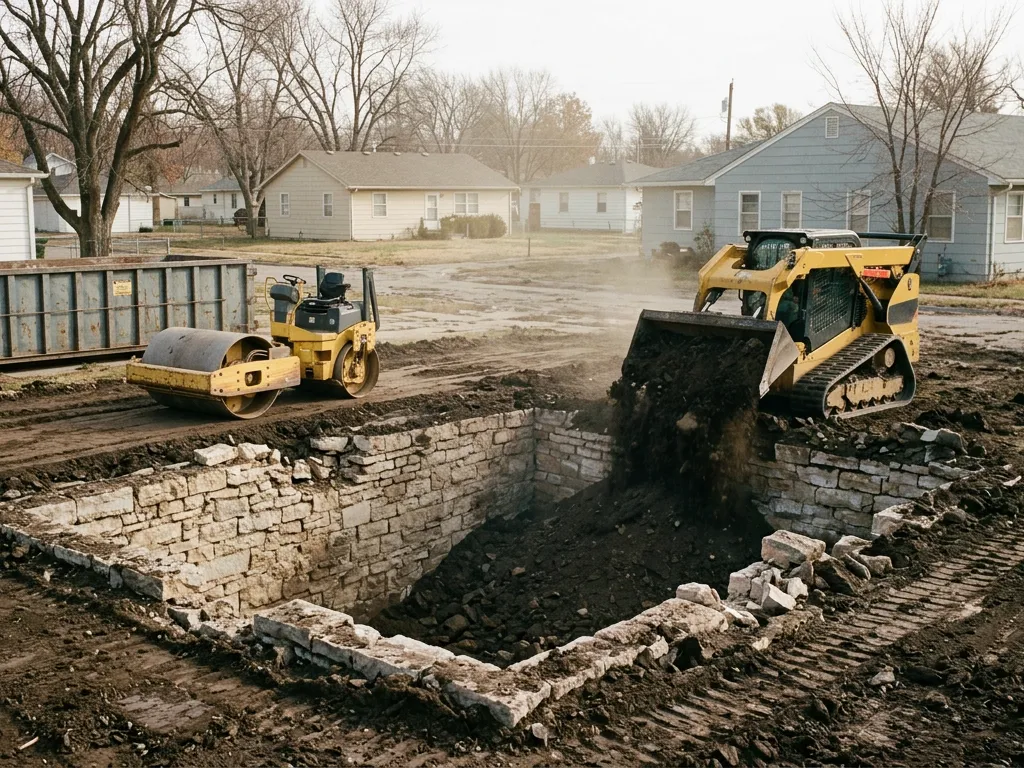
Block, poured and limestone basements broken down, the floor cracked for drainage, and the hole filled with compacted clay that will not sink under the next owner.
- Topeka and 10 towns within 20 miles
- Written price before work starts
- Permit, sewer cap and landfill steps explained
- Local, licensed, insured contractors
Topeka Demolition connects Topeka owners with local contractors for basement removal and fill-in, the part of a house demolition that decides whether the lot is usable afterward or slowly sinks into the shape of the old basement.
Filling and compacting a basement properly costs $5,000 or more; a hole filled with mixed debris and loose dirt can settle under a new house, and fixing that later means excavating it again at a cost that can approach $25,000.
Typical price range
$5,000 to $25,000
The published range for basement demolition (Fixr). It covers breaking or removing the walls, cracking the floor, buying and hauling fill, and compacting it. A small partial basement sits near the bottom; a full basement under a large house, with imported fill, sits near the top.
Calls answered Monday to Friday 7 a.m. to 6 p.m., Saturday 8 a.m. to 2 p.m.
Signs the basement work was done wrong on a past teardown
- A depression in the lawn where a house used to stand
- Bricks, wood or concrete pieces surfacing after rain
- Standing water over the old foundation outline
- Cracks in a newer slab or driveway built over the old basement
- A lender or builder asking for compaction records that do not exist
Remove the walls or break them below grade
There are two sound ways to deal with an old basement. The walls can come out entirely, footings and all, which leaves the most room for a future foundation. Or the walls can be broken off below the finish grade and pushed into the hole, with the floor slab cracked so water drains down instead of pooling in a buried tub. The second costs less; the first is what most builders want if a new house will sit on the same spot.
Limestone foundations and older Topeka houses
Many older houses in Topeka and the towns around it stand on rough-cut limestone foundations. The stone breaks differently from concrete block, and some owners keep the best pieces for landscape walls. Whatever the wall is made of, organic material such as wood framing and roots stays out of the fill, because it rots and leaves voids.
Compaction in clay country
The fill matters as much as the walls. Topeka's soils are mostly smectitic clays that swell when wet and shrink when dry. Fill goes in lifts of about a foot, each compacted with a roller or a plate before the next. The top is finished with topsoil and graded to drain away from neighboring houses. City demolition specifications ask for a site graded to drain and left ready for seed.
Basement work usually follows a house demolition or a fire or storm teardown. In towns with poorly drained soils such as Meriden, getting the grade right matters even more.
Where the fill comes from
A full basement under a typical older house takes a lot of dirt, and the source matters. Clean fill free of organic material, trash and large rubble is what compacts properly. Some contractors balance a lot by cutting high spots on site; most bring fill in by the truckload, which is a large part of the cost. Ask what the fill is and where it comes from.
Broken concrete from the basement walls and floor can sometimes stay in the bottom of the hole if it is clean and placed carefully, which saves trucking. Wood, drywall, shingles and anything that rots never belong in a basement fill.
Questions people ask
How much does it cost to fill in a basement in Topeka?
Published figures for basement demolition run $5,000 to $25,000, depending on size, wall removal or break-down, and how much fill has to be bought and hauled.
Can you just push the house into the basement?
Not soundly. Wood and debris rot and leave voids that settle. The walls can be broken into the hole, but framing and organic material should be hauled away.
What are the signs an old basement was filled badly?
A sinking patch of lawn, debris surfacing after rain, standing water over the old outline, or cracks in anything built on top.
Why crack the basement floor before filling?
So water can drain through instead of collecting in a buried concrete tub, which keeps the fill saturated and soft.
Will a builder want the walls fully removed?
Often, if a new foundation will sit over the old one. Ask the builder before demolition so the contractor prices the right method.
Get a demolition price in writing
Tell the contractor what is coming down, where it is, and what should be left behind: bare dirt, a slab, or a seeded lot.
Call (785) 268-2537