
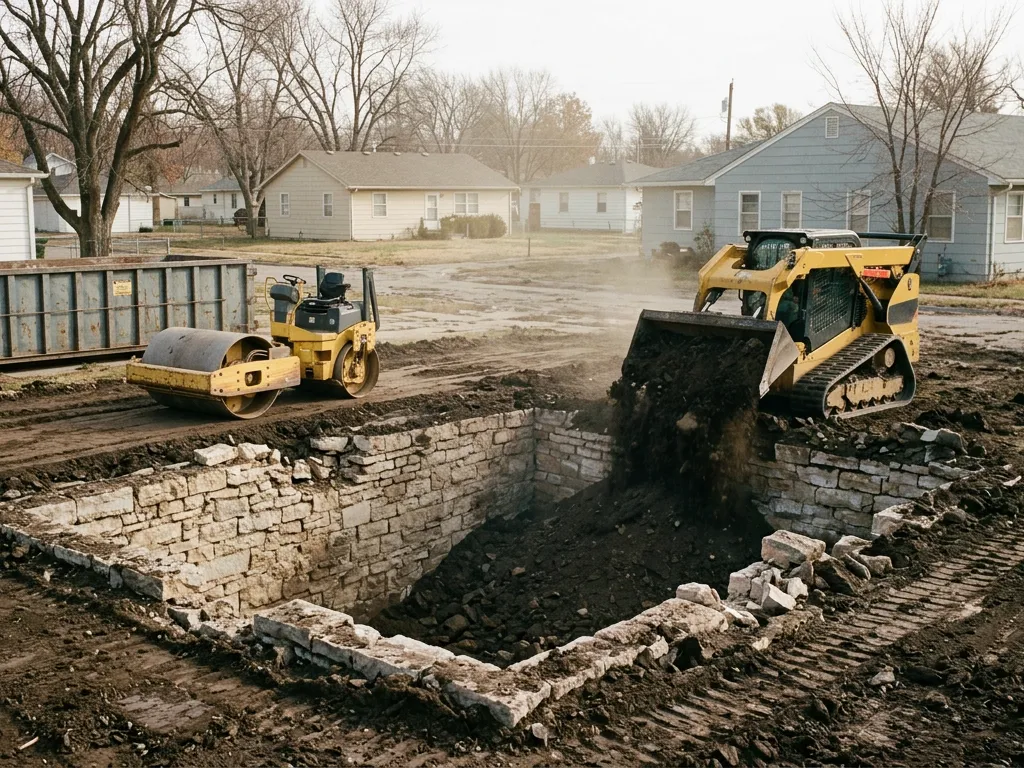
City of Topeka demolition permit
Topeka Demolition: The City of Topeka Demolition Permit, Step by Step
The permit is the easy part. What holds a teardown up is the order: utilities, sewer cap, inspection, then the machine.
- Topeka and 10 towns within 20 miles
- Written price before work starts
- Permit, sewer cap and landfill steps explained
- Local, licensed, insured contractors
Topeka Demolition wrote this guide because "city of topeka demolition permit" is one of the most common things people search before a teardown, and because the permit itself is only one step in a sequence the City inspects in order.
Who issues it and who can do the work
Inside city limits, demolition permits come through the City's Development Services Division, the same division that licenses contractors. Topeka keeps a separate license category for demolition contractors and publishes the list; City demolition bids require bidders licensed as a Demolition Contractor or as a General Contractor for buildings three stories or less. Before you sign with anyone, check that their name is on the current list.
The order the City expects
City demolition specifications lay out the sequence clearly, and a private job that follows the same sequence gives an inspector nothing to object to.
- Utilities disconnected: electric and gas removed at the service, water shut off, and the contractor confirms it before starting.
- Locates called in through Kansas 811 so buried lines are marked.
- Sewer capped at the property line to the City's Standard Engineering Technical Specifications.
- Cap inspected and approved by the City's Construction Inspection Division.
- Demolition permit in hand, along with the contractor's demolition license.
- Structure demolished, debris hauled to a KDHE-licensed landfill, receipts kept.
- Foundation removed or filled, the site graded to drain and left ready for seed.
The sewer cap, explained
The cap seals the house's sewer line where it meets the public system so that dirt, debris and groundwater from the demolition do not go down the City's pipe. It is done before the structure comes down and is inspected before demolition goes ahead. The City's specifications put the cap at the property line, though the inspector can waive that for unusual sites. If the sewer cannot be reached without first removing part of the building, the City's procedures allow the contractor to post a bond instead.
Calls answered Monday to Friday 7 a.m. to 6 p.m., Saturday 8 a.m. to 2 p.m.
Asbestos and the State's 10-day notice
Asbestos is regulated by the Kansas Department of Health and Environment. For an asbestos-related demolition project, written notice goes to KDHE at least 10 working days before work starts (K.A.R. 28-50-8), and the work is done by a KDHE-licensed abatement contractor. KDHE's guidance says homeowners doing work on their own residence are not covered by the Kansas or federal rules, but it strongly encourages care. For a contractor-led teardown of an older house, testing first is the safe order.
Historic properties and their surroundings
Topeka has older neighborhoods with listed buildings. Under K.S.A. 75-2724, a project that will encroach upon, damage or destroy a property on the National or State Register, or its environs, goes to the State Historic Preservation Officer for notice and comment before it proceeds. If the house is old, ask early whether it, or a neighbor, is listed.
Outside Topeka's city limits
In unincorporated Shawnee County, the permit comes from County Land Use and Development, which requires a demolition permit before any building or structure other than a sign or fence is removed. Small cities nearby, such as Rossville, handle permits at city hall, and the counties next door have their own offices. The full teardown sequence is on the house demolition page.
Who does what
On a typical private teardown inside Topeka, the owner decides on the contractor and signs the contract, and requests final meter readings from the utilities if the contractor does not. The contractor schedules the service removals, calls in locates, caps the sewer and arranges the inspection, pulls the demolition permit, and keeps the landfill receipts. The City's Construction Inspection Division inspects the sewer cap; Development Services issues the permit. Agree on this split in writing before the work starts so nothing falls between two people who each thought the other had it.
Common reasons a permit gets held up
Each of these is simple to avoid if it is handled early. The most common delay is waiting on the utilities, so call them first, the same week you decide to demolish.
- Utility services not yet removed when the permit is requested
- The sewer cap not yet inspected, or inspected and failed
- A contractor not on the City's current demolition license list
- Asbestos testing not done on a building that needs it
- A historic listing on the house or a neighboring property
Keep the paperwork
When the job is done, keep the permit, the sewer cap inspection, the asbestos test results and the landfill receipts together. A buyer, a lender or a builder may ask for them, and they are the proof that the lot was cleared the way the City expects.
Garages, sheds and partial demolition
Not every job is a whole house. Taking down a detached garage or removing an attached addition is still demolition of a structure, and inside the city it is worth calling Development Services before scheduling to confirm what applies. Interior demolition that leaves the structure standing is usually handled as part of a remodeling permit rather than a demolition permit. When in doubt, a two-minute call to the City before the work starts costs far less than a stop-work order after it has begun.
The same goes for work in the public right-of-way. Removing a driveway approach or a public sidewalk involves the City even when the house is not coming down.
Before you call the City
Have the property address and the parcel or legal description, the contractor's name as it appears on the City's license list, a short description of what is coming down, and a note of any basement, outbuildings or tanks. If the building is old, find out whether it or a neighbor is on the National or State Register before you schedule anything. Having those details together turns a long back-and-forth into one short conversation, and it shows the contractor and the City that the job is organised from the start.
Questions people ask
Do I need a demolition permit in Topeka?
Yes. Inside city limits, demolition is permitted through Development Services, and the sewer is capped and inspected before work starts.
Can I pull a demolition permit myself as the homeowner?
Ask Development Services. City-contracted work requires a licensed demolition or general contractor, and most owners let the contractor handle the permit and the inspections.
What is the sewer cap requirement?
The sewer line is capped at the property line before demolition and inspected by the City's Construction Inspection Division.
How far ahead do I need to notify KDHE about asbestos?
At least 10 working days before an asbestos-related demolition project, under K.A.R. 28-50-8.
Where does demolition debris have to go?
City specifications require a landfill licensed by the Kansas Department of Health and Environment, with receipts.
What about houses outside the city?
Unincorporated Shawnee County requires a demolition permit from County Land Use and Development for any building or structure except signs and fences.
Get a demolition price in writing
Tell the contractor what is coming down, where it is, and what should be left behind: bare dirt, a slab, or a seeded lot.
Call (785) 268-2537