
Scranton, Osage County
Topeka Demolition in Scranton, Kansas
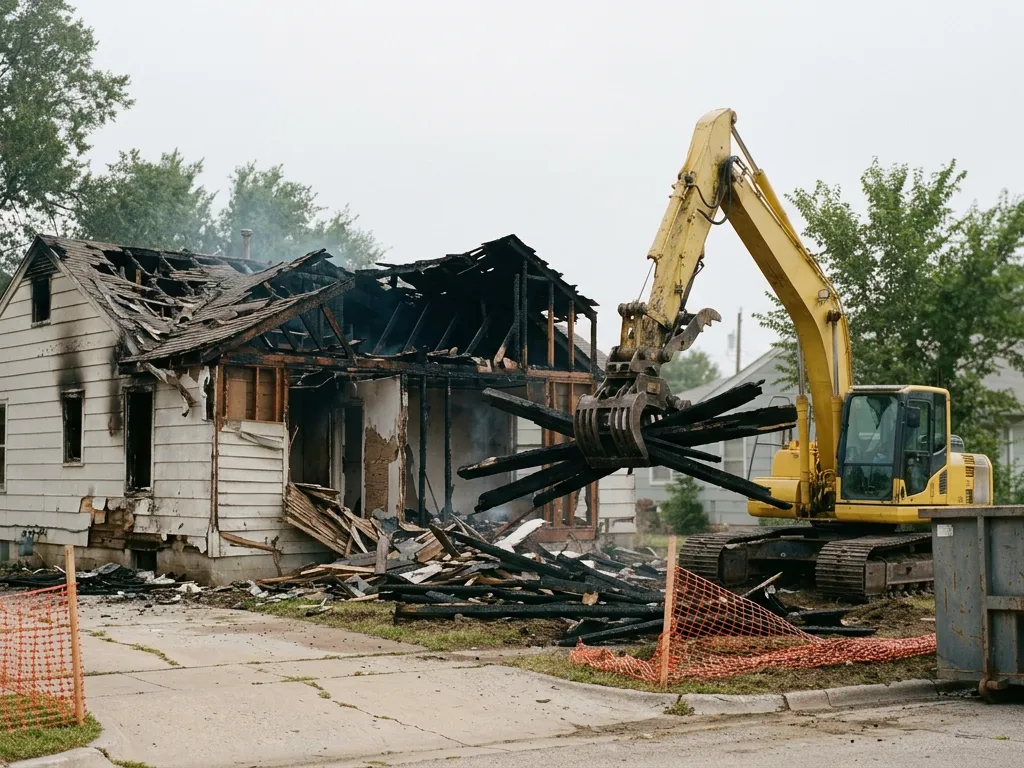
Fire-damaged and vacant houses, garages, outbuildings and old foundations in Scranton and the Osage County coal country south of Topeka.
- Topeka and 10 towns within 20 miles
- Written price before work starts
- Permit, sewer cap and landfill steps explained
- Local, licensed, insured contractors
Topeka Demolition connects owners in Scranton, an Osage County city of about 640 people some 18 miles south of Topeka, with local contractors for fire-damaged and vacant house demolition, garage and outbuilding removal, and the clearing of old foundations in town and on the farms around it.
A fenced, boarded burned house still costs insurance and upkeep every month; a teardown at $6,000 to $25,000 once the claim allows ends that, while a winter of freeze and thaw can drop the shell onto the $1,600 garage beside it.
Typical price range
$9,500 to $20,100
The published Topeka range for house demolition (HomeBlue). Fire-damaged houses fall in the national range of $6,000 to $25,000 because of wet debris and testing, and old foundations run $1,000 to $5,000 to remove.
Calls answered Monday to Friday 7 a.m. to 6 p.m., Saturday 8 a.m. to 2 p.m.
Typical Scranton jobs
- A house damaged by fire and released by the insurer
- A vacant older house that has been empty for years
- A collapsing garage or coal-era outbuilding
- Old stone or concrete foundations on a lot being reused
An old mining town
Coal was dug near Scranton as early as 1867, and the Kansas Carbon Company worked shafts nearby. Like Carbondale, the town kept modest older houses from those years and the decades after. Older houses here can carry stone or early block foundations, plaster walls and materials that should be tested for asbestos before they are broken.
Somewhat poorly drained ground
The USDA soil survey maps the ground at Scranton's center as Woodson silt loam on nearly level slopes, somewhat poorly drained with a dense clay layer below. Water perches on that layer after rain. Old basements tend to hold water, so their floors are cracked before filling, and the finished lot is graded so it does not pond.
Permits and fire jobs
Inside Scranton's city limits, start with city hall; outside town, the Osage County land-use office. For a fire, nothing comes down until the fire investigation and the insurer release the scene; see fire-damaged house demolition. Old slabs and footings on a lot being reused are covered under foundation removal.
Vacant houses in a small town
In a town of Scranton's size, one empty house can sit for years before anyone acts. By then the roof has usually failed, animals have moved in, and the floors may not be safe to walk. Crews do not go inside a structure like that; the excavator works from outside. Owners who inherit a house in this condition often find that demolition and a clean, graded lot are worth more to a buyer than the house was.
If the house has been cited by the city, ask what deadline applies and plan the utility removals and the permit around it.
Coal-era ground and old cellars
Older lots in coal country sometimes hold surprises: old cellars, cisterns and wells that were covered over decades ago, and the occasional pile of cinders or rubble from long-gone buildings. A careful contractor probes the yard before tracking heavy equipment across it. Anything found is filled and compacted as part of the job, and the receipt for the fill becomes part of the paperwork you keep.
Getting a Scranton price
Have the address, the size of the house, any letter from the city or an insurer, and photos from outside. For fire and vacant houses, a contractor prices from a careful walk around the outside, so good photos of every side save time and get a written price in front of you sooner.
Questions people ask
How much does demolition cost in Scranton?
Published Topeka-market figures run $9,500 to $20,100 for a house, with fire-damaged houses in a wider $6,000 to $25,000 range.
What are the signs a fire-damaged house in Scranton is a total loss?
Charred structural framing, a collapsed roof, walls out of plumb, and smoke through the framing. The adjuster makes the call.
Why do old basements in Scranton hold water?
The Woodson silt loam there sits over a dense clay layer that water perches on, so floors are cracked before filling.
Who issues permits in Scranton?
The city inside city limits, and the Osage County land-use office outside them.
Should an old Scranton house be tested for asbestos?
Yes. Houses of that age commonly have it in siding, floor tile or pipe wrap.
Get a demolition price in writing
Tell the contractor what is coming down, where it is, and what should be left behind: bare dirt, a slab, or a seeded lot.
Call (785) 268-2537