
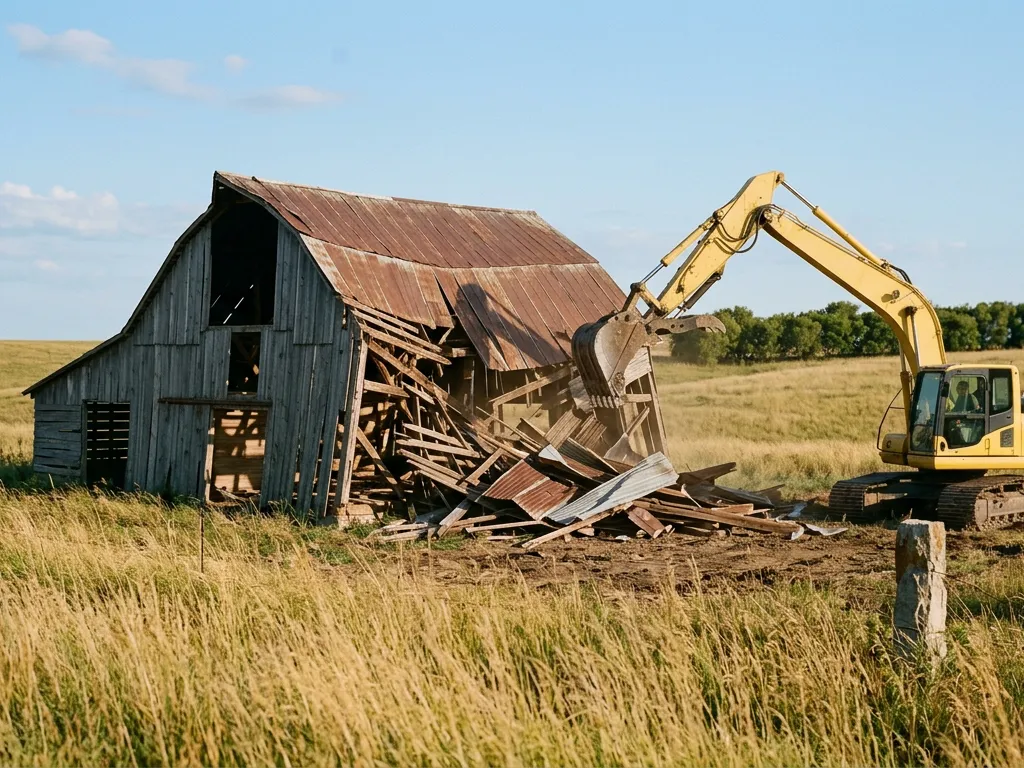
Demolition vs deconstruction
Topeka Demolition: Demolition vs Deconstruction in Topeka, Kansas
Knock it down fast, or take it apart carefully and save the materials. Both are real options around Topeka, and they suit different buildings.
- Topeka and 10 towns within 20 miles
- Written price before work starts
- Permit, sewer cap and landfill steps explained
- Local, licensed, insured contractors
Topeka Demolition gets asked about deconstruction more often each year, especially for barns and older houses around Topeka with wood, brick and stone people would rather see reused than buried, so here is how it compares with conventional demolition.
Two ways to take a building down
Conventional demolition uses an excavator with a grapple to pull the building down and load it out. It is fast, usually a day or two for a house, and it treats most of the building as debris. Metal and clean concrete still get separated for recycling, but wood, drywall, shingles and insulation go to the landfill.
Deconstruction is demolition in reverse. Crews take the building apart by hand and with light machines, in roughly the opposite order it was built: fixtures and trim, then roofing, then framing. Materials are sorted as they come off so they can be reused or sold. It takes days to weeks instead of hours.
What each one costs
Deconstruction costs more in labor. One national guide puts deconstruction of a house at $10,000 to $50,000, against $7,500 to $15,000 for conventional demolition of a 1,500 square foot house. Some of that gap comes back as salvage value, and some owners donate salvaged materials to a reuse organization and claim the donation, which is a question for a tax adviser, not a contractor.
Buildings that suit deconstruction
- Old barns with weathered siding, hand-hewn beams and tin that have buyers
- Houses with old-growth framing lumber, hardwood floors or solid wood doors and trim
- Brick and limestone buildings where the masonry can be cleaned and reused
- Projects where the owner wants to keep particular pieces, such as a mantel or beams
Calls answered Monday to Friday 7 a.m. to 6 p.m., Saturday 8 a.m. to 2 p.m.
Buildings that suit conventional demolition
- Fire-damaged houses, where charred materials have little value and the structure is unsafe to work inside
- Storm-wrecked buildings already in pieces
- Mobile homes and newer buildings of engineered materials with little resale value
- Jobs on a deadline, such as a City order or a closing date
The middle ground most jobs use
Most real jobs fall between the two. A crew strips the valuable items by hand first, such as beams, doors, fixtures and brick, then brings in the excavator for the rest. That captures most of the salvage value without the cost of a full hand deconstruction. Around Topeka, there is also a construction and demolition debris processing center that recovers materials from mixed loads, which helps even on a conventional job.
For barns, see barn demolition, where salvage is often part of the quote. For farm buildings in towns like Meriden, the town page covers the ground and the permit office.
Asbestos and lead change the plan
Hand work on an older house means more exposure to whatever is in its materials. Testing for asbestos and lead paint comes first on either approach, and asbestos found in testing is removed by a licensed abatement contractor before deconstruction or demolition goes ahead.
What salvage is actually worth
Salvage value depends on the material and on finding a buyer. Weathered barn siding and hand-hewn beams can sell well to builders and craftspeople. Old-growth framing lumber, solid wood doors, clawfoot tubs, cast iron radiators and some brick have markets too. Most drywall, carpet, laminate and newer framing have little or no resale value. A contractor who does salvage regularly will know what is worth the hand work and what is not.
Reuse can also mean keeping materials yourself: a beam for a mantel, brick for a garden path, stone from a foundation for a wall. Say so before the job starts.
Time and the schedule
A conventional teardown of a house is usually one to three days of machine work. Deconstruction of the same house can take one to several weeks, depending on how much is salvaged and how carefully. If a buyer, a builder or a City deadline is waiting, the longer schedule may not fit. The hybrid approach, hand-stripping the valuable pieces and then using the machine, usually adds a few days rather than a few weeks.
Questions to ask before choosing
- What in this building has resale value, and roughly how much?
- How much longer will deconstruction take than demolition?
- Who keeps or sells the salvage, and is it credited on the invoice?
- Will the salvaged materials be tested for lead paint?
- What still goes to the landfill either way?
How the choice plays out around Topeka
Around Topeka, the most common place deconstruction makes sense is the old barn or farmhouse on an acreage, where weathered wood and timbers have buyers and there is room to sort and stack materials. In the city, most houses come down conventionally, with a few valuable pieces pulled first. Topeka also has a construction and demolition processing center that recovers materials from mixed loads, so even a conventional job can keep a share of its debris out of the landfill.
Whichever route you choose, the City's steps do not change: utilities removed, the sewer capped and inspected inside city limits, the permit issued, and debris taken to a licensed landfill or a recycler with receipts.
Lead paint and older materials
Salvaged wood from an older building often carries lead paint, and reusing it indoors or selling it to someone who will sand it is a risk worth naming. Test painted pieces before they leave the site, and tell any buyer what you know. Brick and stone are usually safe to reuse once old mortar is knocked off. Fixtures such as sinks and tubs are fine to reuse, but old pipe insulation and some flooring should be tested for asbestos before anyone pulls them up by hand. Deconstruction puts people closer to these materials for longer than a machine teardown does, which is one more reason testing comes first.
Questions people ask
What is the difference between demolition and deconstruction?
Demolition pulls the building down with machines and hauls most of it away. Deconstruction takes it apart by hand so materials can be reused.
Is deconstruction more expensive?
Usually, in labor. One national guide puts house deconstruction at $10,000 to $50,000 against $7,500 to $15,000 for conventional demolition, with salvage offsetting part of the gap.
How long does deconstruction take?
Days to weeks for a house, compared with a day or two for a machine teardown.
Can I keep some materials from a regular demolition?
Yes. Ask for items to be set aside before the machine starts, such as beams, brick or a mantel.
Is deconstruction a good idea for a burned house?
Rarely. Charred materials have little value and the structure is unsafe to work inside, so machine demolition is the usual choice.
Get a demolition price in writing
Tell the contractor what is coming down, where it is, and what should be left behind: bare dirt, a slab, or a seeded lot.
Call (785) 268-2537